Self-cultivation, Harmony in Dealing with the World, Honesty in Treating People, and Integrity in Business
Approved by the Ministry of Commerce of China, a professional international exhibition company with the qualification to hold exhibitions both domestically and internationally.
Email:

Details
Africa's largest city — Lagos (Photo gallery)
06-19
In Lagos, Nigeria, economic prosperity has widened the gap between the rich and the poor.
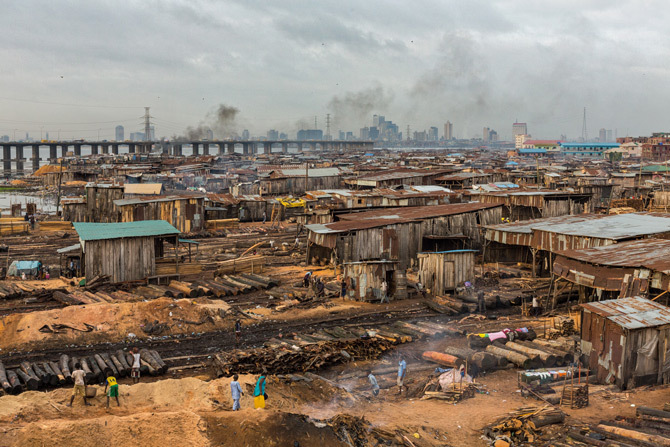
Thousands of people live and work in the sawmill area of mainland Lagos. In recent years, a blend of factories and shanties, which had doubled in size, has been ravaged by fire. Behind the Third Mainland Bridge, the high-rise buildings that generate Nigeria's wealth are vaguely visible across the Lagos Lagoon.

Almaz enjoys Lagos's evolving cultural scene; this photo was taken by her for the African Artists' Foundation. "Lagos is a very vibrant society," she said. "If you want your dreams to come true, for better or worse, come to Lagos. Trust me, it will happen."

At the end of the workday, vans flood into the Idumota market on Lagos Island to pick up workers returning to their homes on the mainland, where most Lagosians live.

Young entrepreneurs from the Lagos Cigar Club are part of the city's rapidly growing upper class, enjoying a relaxing moment at a hotel on Victoria Island.

Hawkers peddle goods in many markets on Lagos Island, displaying entrepreneurial enthusiasm that makes Nigeria's economy one of Africa's most vibrant.

Lakowe Lakes Golf & Country Estate is a gated residential community that offers the wealthy a stylish retreat not far from the bustling business centers.

Girls wash clothes or boil peanuts to sell among dilapidated residential buildings, which are among many low-cost housing units built by the Lagos State Government thirty years ago as affordable communities.

Rotimi Alakija adjusts an Italian suit. He is the general manager of an oil company and the son of Nigeria's first female billionaire.

On the outskirts of Lagos, Friday night Holy Spirit services at the Redemption City's mile-long convention center attract thousands of worshippers. Redemption City, operated by the Redeemed Christian Church of God, has approximately 10,000 residents, several schools, a university, some banks and shops, and reliable water and electricity supply.

In a small classroom within a row of shops, Innocent Lewis teaches adults how to type on a keyboard to improve their employment prospects.

Nigeria typically requires guests to wear color-coordinated outfits for social occasions, such as this wedding held at the Yoruba Tennis Club.

Students from the elite Saviour's Primary School celebrate their annual "Happy Day" with family and friends playing together. This affluent Ikoyi community school teaches the national curriculum in English.

A spacious bedroom in the Okafor family home on Banana Island. This artificial island in the Lagos Lagoon, shaped like a banana, is one of the city's most expensive neighborhoods, favored by foreigners working for large corporations. The Okafors grew up in Lagos, trained as lawyers, but are now in business.

A customer carefully selects items in the grocery aisle of the Ikeja Shopping Centre, a three-year-old mall operated by South Africa-based Shoprite.

A dancer, who will appear in a TV production by the music group "Double Win", is getting her makeup done, while a woman prepares to sell food on set.

An actress and an actor flirt and dance in a scene from the film "Who Is That Foolish Wife?". This Yoruba-language film was shot with just one camera and three lights.

A ball held at a stylish hotel on Victoria Island after the 2014 Africa Movie Academy Awards, celebrating the highest achievements of the African film and television industry for the year.

Peter Etumudon sings for a TV shoot. He and his twin brother Paul formed a music group called "Double Win".

Residents of one of the dilapidated apartment complexes built by the Lagos State Government in the 1980s watch a Nollywood film being screened at a DVD store.
Previous
Latest News
Address: 9th Floor, Building 1, Xiangtai Plaza, No. 129, Yingxiongshan Road, Shizhong District, Jinan City, Shandong Province
Postcode: 250002

Official WeChat Official Account

Video Number Search
Zhenghe International Exhibition

Douyin Search
Zhenghe International Exhibition
Copyright ©